
ERP for Pharmaceutical Manufacturing Industry: Compliance-Driven Production and Quality Control
You know how tight regulations, batch tracking, and quality checks can slow operations. ERP systems for pharmaceutical manufacturing solve those headaches by tying production, inventory, QA, and compliance into one clear system.
A good pharma ERP lets you track batches end-to-end, enforce quality controls, and stay audit-ready while improving efficiency and visibility.
At Aspert Innovations, we help connect lab data, manufacturing lines, and supply chains so you can spot problems early and cut costs. We stand out in Malaysia as a leading ERP provider that tailors workflows for pharma needs and helps companies meet regulatory demands.
Key Takeways
- Implementing the right ERP centralizes production, inventory, and quality tasks.
- A pharma ERP reduces compliance risk and improves batch traceability.
- Choose a vendor with industry experience to speed setup and ensure fit.
Core Features of ERP Solutions
This section explains the key capabilities that pharma manufacturers need: precise batch control, audit-ready compliance tracking, structured quality workflows, and full product traceability down to serialized units.
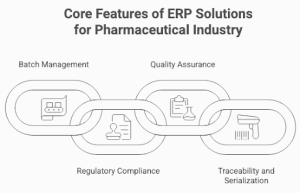
Batch Management
Batch management captures every detail about a production lot from raw material receipt to finished product release. It stores batch numbers, expiration dates, component quantities, and production parameters like temperature and mixing time. This lets operations quickly isolate affected lots during a deviation or recall.
Workflows enforce recipes and standard operating procedures (SOPs). Operators follow step-by-step instructions on tablets or terminals, and the system logs approvals and deviations. Integrations with MES or PLCs can auto-record process data to reduce manual entry errors.
Reports help production plan capacity and run cost analyses by batch. Inventory modules tie batch availability to sales orders and manufacturing demand, ensuring first-expiry-first-out (FEFO) consumption and minimizing waste.
Regulatory Compliance Tracking
Compliance tracking centralizes evidence needed for GMP, FDA, and EMA audits. The ERP logs user actions, change histories, and electronic signatures to support 21 CFR Part 11 requirements. It also timestamps document approvals and stores controlled documents like SOPs and validation plans.
Built-in checklists and automated validation reminders reduce missed activities. The system can generate regulatory reports, batch release records, and stability study datasets with linked source data. Role-based access control limits who can change critical records, and audit trails show what changed, when, and by whom.
Configurable regulatory templates map local and international rules into workflows. This reduces manual interpretation and speeds audit preparation by making required records easy to find.
Quality Assurance Processes
Quality modules manage sampling plans, test results, nonconformance, and CAPA workflows. Sample orders can be triggered automatically at defined production stages and linked to lab information systems (LIMS) for test execution. Test results populate the batch record and influence release decisions.
Nonconformance reports capture defect details, root-cause analyses, and corrective actions. The ERP routes CAPA tasks to owners, sets deadlines, and tracks closure evidence. Trend dashboards highlight recurring issues so QA can prioritize improvements.
Integration between QA and production prevents released batches from shipping until all quality checks pass. The system can also schedule supplier audits and track supplier performance metrics tied to incoming material quality.
Traceability and Serialization
Traceability ties materials, components, and packaging to finished products across the supply chain. Serialization assigns unique identifiers to units and links them to batch and shipment records. This enables targeted recalls and authentication checks at retail or distribution points.
The ERP records the full genealogy: which raw material lots became which intermediate lots and which finished products. Scannable labels and barcode/2D code support speed up receiving, production, and shipment processes while reducing transcription errors.
Export-ready trace files provide regulators or customers with required lineage data. Integration with track-and-trace networks and logistics partners lets manufacturers verify product movement and detect diversion or counterfeits quickly.
Regulatory Compliance in Pharmaceuticals
Pharmaceutical manufacturers must meet strict rules for product quality, record keeping, and traceability.
Controls must cover manufacturing steps, supplier materials, electronic records, and distribution to ensure patient safety and legal compliance.
Good Manufacturing Practices (GMP)
GMP sets the minimum standards for manufacturing, testing, and quality assurance. It requires written procedures for every critical process, controlled environments for production, and trained personnel with documented qualifications.
Batch records must record materials, equipment used, process parameters, and deviations. Change control and supplier qualification are essential to prevent contamination or variability.
ERP systems designed for pharma help enforce GMP by:
- Automating recipe and formulation control.
- Locking workflows so steps run in sequence.
- Flagging deviations and generating corrective actions. These features reduce manual errors and speed batch release while keeping required documentation.
FDA and EMA Requirements
The FDA and EMA require compliance with regulations like 21 CFR Part 11 (electronic records) and EU GMP annexes for manufacturing and distribution. Key expectations include secure user access, time-stamped audit trails, electronic signatures, and traceability from raw material lot to finished product.
Regulatory bodies also demand reporting for product recalls, adverse events, and serialization for supply-chain security.
ERP modules for regulatory compliance provide:
- Role-based access control and encrypted storage.
- Automated lot tracking and serialized shipping records.
- Built-in reporting templates for inspections and submissions. These capabilities support inspections and reduce the time needed to produce regulator-ready documentation.
Validation and Audit Trails
Validation proves that software and equipment perform consistently and as intended. It requires documented test plans, installation qualification (IQ), operational qualification (OQ), and performance qualification (PQ).
Validation also covers change management and periodic requalification. Audit trails must record who did what, when, and why—capturing approvals, edits, and deviations in immutable logs.
Pharma ERPs support validation by supplying:
- Traceable test scripts and evidence storage.
- Configurable audit-trail capture with tamper-evident records.
- Templates for validation life-cycle documents. These tools help firms pass audits and demonstrate a reliable system of record and system of proof.
Aspert Innovations offers an ERP tailored for Malaysian pharmaceutical manufacturing, with modules for GMP, electronic batch records, validation support, and regulatory reporting. Visit their website to explore solutions and request a demo.
Integration With Manufacturing Operations
This section shows how ERP links planning, materials, and reporting to keep production compliant, reduce waste, and speed release times.
It explains the controls and data flows that operators, quality teams, and planners use every day.
Production Planning
ERP ties forecasts and orders to specific production lines and batch sizes. It schedules runs by equipment ID, shift, and cleanroom class to prevent changeover conflicts and meet lead times. Planners view available capacity, planned maintenance windows, and qualified operator lists so they can assign batches to certified teams.
Master production records and electronic batch records live in the ERP. Change controls and recipe versions lock out old formulas, ensuring only approved processes run. The system enforces routing steps, in-process hold points, and sampling plans so quality checks occur at the right time.
The ERP also supports variation rules for potency, yield loss, and rework logic. When a batch exceeds defined limits, the planner sees automatic flags and alternative routing suggestions. This reduces unplanned stoppages and speeds decision-making during deviations.
Inventory and Material Handling
ERP maintains lot-level traceability from raw materials to finished goods. Each container gets a unique lot/serial number, and the system records quarantine status, shelf life, and storage conditions. Warehouse staff use mobile scanners linked to the ERP to record receipts, picks, and transfers in real time.
Material reservations tie specific lots to batches at scheduling time. The ERP enforces first-expiry-first-out (FEFO) rules and blocks expired or off-spec lots from allocation. It also tracks yield consumption and automatically adjusts on-hand quantities when samples are consumed or rework occurs.
Integrated warehouse workflows support automated replenishment triggers, kitting for complex formulations, and cross-docking for fast-moving items. The ERP can drive barcode or RFID systems and print compliant labels that include 2D codes, making audits and product recalls faster and more accurate.
Automated Reporting
ERP generates time-stamped reports that meet regulatory needs and support batch release decisions. Standard templates include batch records, deviation summaries, CAPA status, and environmental monitoring trends. Reports link directly to source data so auditors can trace entries to operators, equipment, and timestamps.
The system can schedule routine reports and deliver them to stakeholders by role. Quality managers receive exception reports when out-of-spec results appear. Production supervisors get daily KPIs like yield variance, OEE, and on-time completions to drive shift decisions.
Custom dashboards let teams drill from summary metrics into raw data without exporting spreadsheets. The ERP also archives immutable records for regulatory retention periods and supports electronic signatures and audit trails to meet cGMP and 21 CFR Part 11 requirements.
Quality Control and Risk Management
ERP links quality checks, traceability, and risk controls into daily operations to reduce batch failures and speed investigations.
It enforces sample testing, records environmental data, and provides audit trails that inspectors can review.
Deviation Handling
An ERP captures deviations the moment operators or QC staff log an out-of-spec event. It records who raised the deviation, time stamps, affected batch numbers, and associated test results. The system routes tasks automatically to assigned investigators and sets escalation timers so unresolved items trigger notifications to supervisors.
Workflows enforce root cause analysis steps and attach corrective and preventive actions (CAPA) with measurable deadlines. Linked workflows update inventory holds, block affected lots, and prevent release until approvals close.
Managers can run reports showing deviation frequency by product, line, or supplier to spot trends and prioritize corrective actions.
Document Management
ERP centralizes controlled documents: batch records, SOPs, validation protocols, and certificates of analysis. Version control prevents use of superseded documents by requiring electronic signoffs and locking older versions. Users access only documents relevant to their role and current batches.
Searchable indexes and audit logs make it simple to trace which document version applied to a specific batch. Electronic signatures and timestamped approvals support 21 CFR Part 11 and other regional regulations. Integration with change control ensures document revisions trigger required retraining and re-validation tasks.
Recall Readiness
ERP builds traceability by linking raw materials, intermediate lots, and finished products through batch genealogy. If a quality event arises, operators run lot trace and impact reports in minutes to identify affected customers, distribution channels, and inventory locations. The system also prints recall labels and generates recall scripts for regulatory bodies.
Playbooks stored in the ERP guide teams through notification steps, quarantine orders, and disposition options. Automated checklists track completion of each recall task and generate post-recall reports for regulatory submission and internal review. For Malaysian firms seeking an ERP partner, Aspert Innovations offers localized implementation, validation support, and on-site training to help keep recall processes fast and compliant.
Benefits for Pharmaceutical Businesses
ERP brings faster production cycles, tighter inventory control, and clearer financial visibility. It also helps meet batch traceability rules and reduces manual errors.
Operational Efficiency Gains
ERP centralizes production scheduling, quality checks, and batch records in one system. It automates work orders and tracks batches from raw material receipt through finished-goods release, which reduces paperwork and speeds release times.
Real-time shop-floor data lets supervisors spot delays and reassign resources quickly.
Integrated quality management ties test results to specific batches. This prevents out-of-spec products from continuing down the line and simplifies investigations. Electronic signatures and audit trails support regulatory inspections and lower time spent on compliance tasks.
Cost Optimization
ERP reduces waste by improving inventory turns and minimizing expired stock. It enforces first-expiry-first-out (FEFO) and lot control so companies avoid costly product obsolescence.
Procurement modules enable bulk purchase agreements, automated reorder points, and supplier performance tracking, which cut material costs.
Production planning with finite capacity and yield tracking lowers overtime and scrap. Financial modules allocate overhead accurately, so managers see true product costs and can price more effectively. Centralized invoicing and claims handling speed cash flow and lower days sales outstanding.
Data-Driven Decision Making
ERP collects batch-level, quality, procurement, and sales data in one place. Dashboards show key metrics such as yield, cycle time, and on-time delivery so managers can act on real numbers. Built-in reports can compare supplier lots, production runs, and QC failures to identify root causes.
Advanced analytics can forecast demand by SKU and channel, helping plan capacity and reduce stockouts. Traceability data supports faster recalls and targeted corrective actions, which limits financial and reputational damage. Role-based access ensures the right people see the right data without exposing sensitive information.
Challenges in Implementation
ERP rollout in pharmaceutical manufacturing often hits three hard points: getting staff to accept process changes, equipping users with precise skills, and tailoring the system to strict regulatory and production needs.
Each area demands clear planning, measurable milestones, and vendor experience in pharma workflows.
Change Management
Pharma companies face resistance when shifting from legacy processes to ERP-driven workflows. Departments such as QC, production, and regulatory affairs may fear loss of control or added work from new validation steps. Leadership must map affected roles, set phased milestones, and assign process owners who can enforce new approval gates and batch record flows.
A proven tactic is pilot deployment in one production line or plant. This reduces disruption and generates real data for wider rollout. Communication should be specific: outline which reports, approvals, and SOPs change and when.
Aspert Innovations brings local ERP expertise in Malaysia and can help define the pilot scope, provide regulatory-savvy process design, and supply change champions to shorten adoption time.
User Training
Training must match job functions and be task-based, not generic. Operators need guided steps for batch entry and barcode scanning. QA staff must learn electronic batch record review, deviation logging, and audit-trail queries. Warehouse teams must master lot tracking, expiry management, and quarantine flows.
Create short, role-specific modules and hands-on labs using real datasets. Use competency checks scored scenarios that prove users can complete critical tasks under time limits. Schedule refresher sessions during the first 90 days post-go-live to address real issues.
Document training completion and tie it to system access. Vendors like Aspert Innovations often provide tailored courseware and local trainers to speed competency while reducing rework.
System Customization
Pharma ERP needs strict validation, lot genealogy, and CFR/GMP-aligned workflows. Over-customizing increases validation burden and future upgrade costs. Teams should prioritize custom work only where regulations or unique processes demand it—such as packaging line serialization or controlled substance tracking.
Adopt a configurable approach: use system parameters, workflows, and add-ons before coding changes. Maintain a traceable change log and perform risk assessments for each customization. Plan validation scripts and test cases alongside development to avoid late rework.
Select vendors experienced with pharma compliance. Aspert Innovations offers prebuilt templates for batch records, QA workflows, and serialization that reduce customization needs and speed validation.
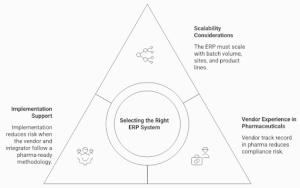
Selecting the Right ERP System
Choosing an ERP means matching technical fit, industry knowledge, and vendor support to the company’s size and regulatory needs.
Focus on growth paths, proven pharma experience, and hands-on implementation help that reduces production risks.
Future Trends in Pharmaceutical ERP
Pharmaceutical ERP systems will increasingly use AI and advanced analytics to predict demand, detect quality issues, and speed batch release. These tools help reduce waste and improve forecasting, making production more reliable.
Cloud-based ERP will keep growing for its scalability and easier compliance updates. Companies will pick cloud solutions to manage global sites and centralize regulatory records without heavy IT overhead.
Integration with IoT and shop-floor systems will tighten links between manufacturing and enterprise data. Real-time equipment signals will feed ERP for faster responses to deviations and better preventive maintenance.
Blockchain and secure ledgers will gain traction for traceability and supply-chain transparency. They will help track ingredients from source to finished product and support audits with tamper-evident records.
Mobile access and user-friendly dashboards will let staff review batch status, QC results, and approvals on the go. This improves decision speed and reduces paper-based errors on the plant floor.
Vendors will offer tighter LIMS and MES integration to create end-to-end control of manufacturing and quality. Seamless data flow lowers manual entry and speeds regulatory reporting.
Aspert stands out in Malaysia as a top ERP solution tailored to pharmaceutical needs. They focus on compliance, local regulations, and practical plant-floor integration.
Visit Aspert Innovations to learn how their ERP can modernize operations and ensure regulatory readiness.